Article: The Omega Chronostop
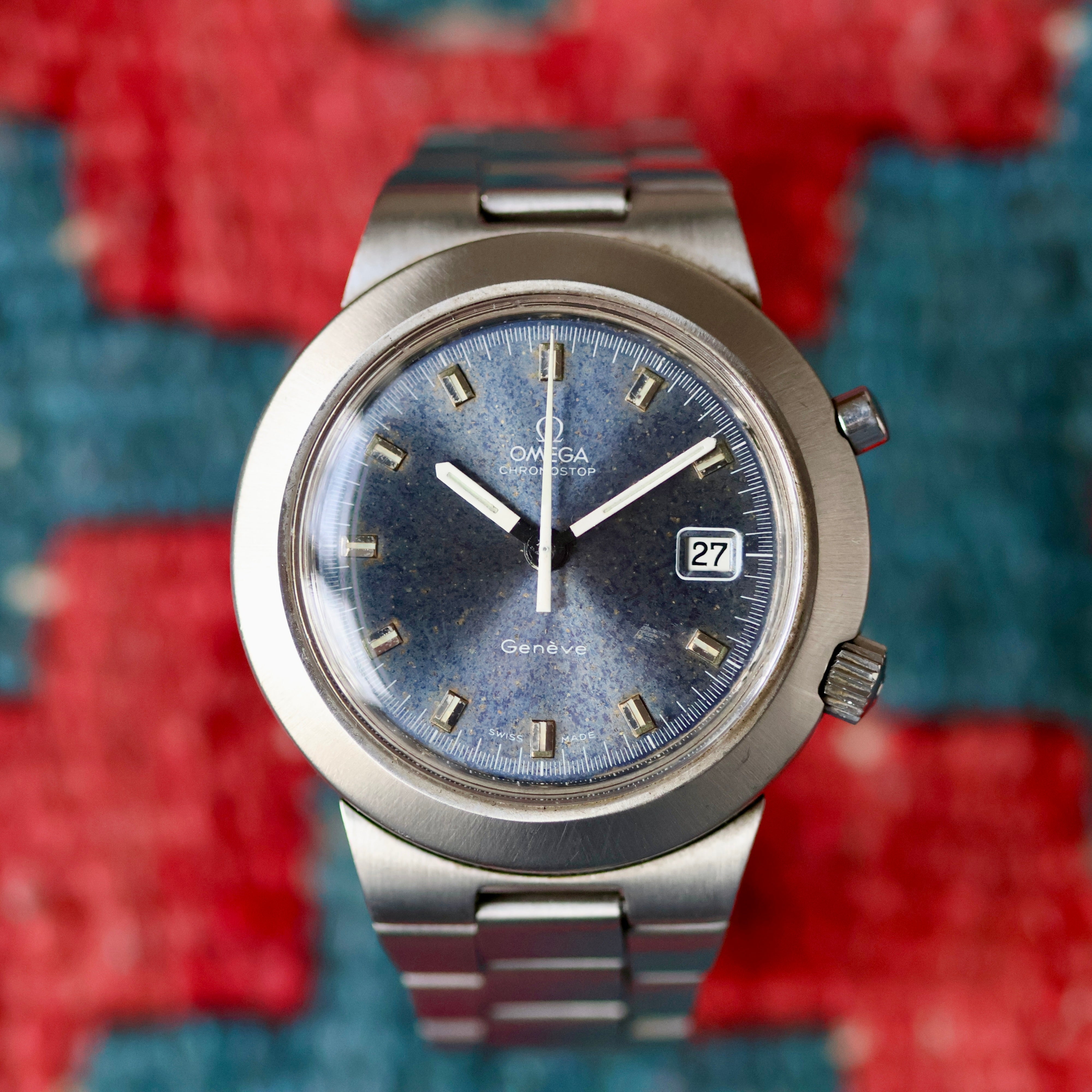
The Omega Chronostop
Omega Chronostop: The Clever One-Button Chronograph
Introduction
In the world of vintage Omega, few models strike the balance between accessibility, bold design, and mechanical ingenuity quite like the Omega Chronostop. Among its various iterations, the round-case Chronostop with the blue dial stands out distinctly—not only for its crisp, sporty aesthetics but also for the compelling story it tells about Omega's 1960s spirit of experimentation. Furthermore, this timepiece represents a pivotal moment in watchmaking history when innovation meant simplification rather than complexity. To explore more about iconic vintage watches, check out our comprehensive guide to vintage Omega watches.
A Brief History of the Omega Chronostop: Timeline and Evolution
Omega introduced the Chronostop in 1966–67 as part of the Seamaster line. Subsequently, the brand later expanded it into the Genève collection. Moreover, it arrived at a time when Omega was pushing boundaries across all segments: professional diving watches, the burgeoning Speedmaster line, and stylish everyday sports watches. For more context on this era, explore our guide to Omega watch history.
The Mission Behind the Single-Pusher Chronostop Timer
The Chronostop was designed with a clear and purposeful mission:
- Offer a true Swiss chronograph
- Provide affordability with a slimmer profile
- Utilize a simplified, intuitive timing mechanism
Rather than compete directly with traditional multi-register chronographs like the Speedmaster, Omega envisioned the Chronostop as a timer for active, urban professionals—specifically drivers, students, and travelers—who needed to measure short intervals on the fly. Consequently, this strategic positioning differentiated the Chronostop in the marketplace. Additionally, for comparison with other Omega chronographs, see our Speedmaster vs other Omega chronographs article.
European and South American Success: Market Dominance of the One-Button Watch
The model became especially popular in Europe and South America. In fact, it was marketed heavily during the late 1960s as a youthful, modern alternative to complex chronographs. Therefore, the Chronostop captured a demographic that valued simplicity and practical functionality. Moreover, its success in these regions established it as a significant player in the sports watch category.
The Round-Case Omega Chronostop Models: Classic Design Variants
While many enthusiasts know the driver-oriented "wedge-shaped" Chronostop, the earliest and most classic versions came in round cases (references like 145.009 and 146.009). Additionally, these round-case models represent the original vision for the collection. For deeper insights into Omega case styles, explore our guide to Omega watch cases and references.
Why the Blue-Dial Omega Chronostop Variant Is Highly Sought-After
The blue-dial variation is one of the most sought-after today. Specifically, collectors prize this version for several compelling reasons:
- Its deep sunburst finish that catches light beautifully
- Excellent legibility under various lighting conditions
- Clean, minimalist design that transcends trends
- Timeless balance between sport and elegance
Moreover, the blue dial exemplifies the sophisticated color palettes that Omega favored during the 1960s. Notably, this aesthetic choice ensures the watch remains visually relevant decades after its production. Furthermore, vintage watch collectors consistently rank the blue-dial Chronostop among the most desirable vintage sports watches. To learn more about dial colors and vintage watch aesthetics, check our vintage watch dial colors guide.
How the Single-Pusher Chronostop Mechanism Works: Engineering Excellence and Innovation
At the heart of the Chronostop lies the Omega Calibre 865 (time-only) or Calibre 920 (with date). Both movements were based on the reliable, manual-wind Calibre 860 family. However, Omega modified these movements specifically to support a unique mono-pusher timer. Consequently, this engineering solution demonstrates the brand's innovative problem-solving approach. For technical details on Omega movements, visit our Omega caliber guide.
The Chronostop as a 60-Second Timer: Not a Traditional Chronograph
The Chronostop is essentially a 60-second timer. Importantly, there are no subdials, no hour or minute counters, and no permanent running seconds. Therefore, this streamlined design keeps the movement thin and straightforward. Additionally, this simplification approach reduces mechanical complexity considerably. This design philosophy differs dramatically from traditional chronographs, making the one-button timer conceptually unique.
One Button, Three Actions: The Innovative Mono-Pusher System
The brilliance of the Chronostop lies in the pusher at 2 o'clock, which performs all timing functions:
Start – Press the pusher once to activate the timer
Hold to read – Press and hold to stop the hand at the elapsed time
Release to reset – Let go, and the hand snaps back to zero instantly
This ingenious design gives the user the ability to time short events (crossing a street, brewing tea, timing a lap, etc.) with remarkable smoothness and no fuss. Consequently, the single-pusher system feels intuitive and natural to operate. Moreover, this tactile experience distinguishes the Chronostop from all competing designs of the era.
How the One-Button Mechanism Actually Achieves Multi-Function Timing: Technical Deep Dive
Inside the movement, Omega redesigned the chronograph heart and hammer system in a groundbreaking way:
Starting the chronograph disengages a brake, allowing the central seconds hand to run continuously.
Holding the button re-engages the brake. Notably, this does not trigger the reset hammer, allowing the user to read the elapsed time.
Releasing the pusher immediately activates the hammer, resetting the hand to zero instantly.
In contrast, standard chronographs operate differently:
You have separate pushers for start/stop and reset functions.
Resetting is only allowed when the chronograph is stopped.
Furthermore, the Chronostop mechanism combines these actions elegantly into one continuous, intuitive motion. Therefore, the user experience feels fluid and satisfying in a way that traditional chronographs cannot match. For more on how chronographs work, explore our watch chronograph explanation guide.
Why Enthusiasts Still Love the Omega Chronostop Today: Enduring Appeal
Unique Wearing Experience: Tactile and Satisfying One-Button Operation
Timing with a Chronostop feels tactile and almost playful. In fact, the experience of pressing, timing, and releasing creates a fluid, satisfying interaction with the watch. Moreover, this hands-on engagement distinguishes the Chronostop from more passive timepieces. Therefore, owners report genuine joy in using this watch daily.
Iconic 1960s Omega Design: Timeless Aesthetics and Vintage Appeal
The round blue-dial version showcases classic late-'60s features that remain visually compelling:
- Bold, readable indices
- Clean, elegant typography
- A sophisticated pop of color without excessive ornamentation
- Minimalist design philosophy
Notably, these design elements have proven timeless. Consequently, the watch never appears dated or overly specific to its era. Additionally, for appreciation of vintage design principles, see our vintage watch design trends article.
Great Entry Point into Vintage Omega: Accessibility and Affordable Value
Compared to Speedmasters or Seamaster 300s of the same era, the Chronostop remains relatively affordable while delivering genuine historical and mechanical significance. Additionally, this accessibility makes it an excellent gateway watch for collectors entering the vintage Omega market. Therefore, new collectors can acquire a piece of horological history without premium investment. Moreover, for guidance on building a vintage watch collection, check our how to start collecting vintage watches guide.
A Clever Horological Concept That Never Got Copied: Unique Innovation Legacy
No other major brand has produced a timer quite like this. Specifically, the single-pusher "press-and-hold" reading system remains a distinctive Omega innovation to this day. Therefore, the Chronostop holds a unique place in watchmaking history that competitors never successfully replicated. In fact, major manufacturers like Rolex, Seiko, and Tag Heuerdeveloped alternative solutions rather than copying this elegant approach.
The Omega Chronostop vs. Other Vintage Chronographs: Comparison and Differentiation
The One-Button Chronostop Differs from the Speedmaster Professional: Design Philosophy Contrast
While the Speedmaster Professional is celebrated as a robust, multi-function chronograph, the Chronostop takes a fundamentally different approach. Specifically, the Speedmaster emphasizes versatility with multiple registers and timing capabilities. Conversely, the Chronostop prioritizes elegance and simplicity through its single-function design. Therefore, they serve different collector preferences entirely. For detailed comparison, explore our Omega Chronostop vs Speedmaster article.
Why Collectors Appreciate Both Omega Chronographs: Multiple Perspectives
Furthermore, many serious Omega enthusiasts appreciate both watches for different reasons. In particular, the Speedmaster appeals to those seeking comprehensive timing functions. Meanwhile, the Chronostop attracts collectors who value clever engineering and minimalist design philosophy. Notably, owning both represents a well-rounded vintage Omega collection. Additionally, for comprehensive Omega options, explore our complete Omega chronograph buying guide.
Collecting the Omega Chronostop: Practical Considerations for Prospective Buyers
Condition and Rarity Factors: What to Evaluate
Today, finding a well-preserved round-case Chronostop with a blue dial requires patience and resources. Moreover, original dials in excellent condition command premium prices. Therefore, condition assessment is paramount when evaluating potential purchases. Additionally, understanding dial originality versus refinishing is crucial for informed collecting. For expert advice, see our vintage watch condition assessment guide.
Market Appreciation: Investment Potential and Collector Demand
The Chronostop has experienced steady appreciation over the past decade. Consequently, acquiring one now represents a sound investment for collectors. Additionally, the rarity and unique mechanism ensure continued collector interest. Furthermore, demand from international collectors has strengthened market prices considerably. To track vintage watch values, visit WatchCharts for current market data.
Maintenance and Servicing: Specialized Care for the One-Button Timer
Importantly, the specialized single-pusher mechanism requires knowledgeable horologists for servicing. Therefore, prospective owners should ensure access to qualified watchmakers familiar with this specific caliber before purchasing. Moreover, establishing relationships with experienced vintage Omega specialists is essential for long-term ownership satisfaction. Additionally, for service recommendations, consult NAWCC (National Association of Watch and Clock Collectors) for certified watchmakers.
The Legacy of Simplification in Horology: Design Philosophy and Innovation
The Omega Chronostop exemplifies a broader principle in watchmaking: sometimes innovation means subtraction, not addition. In fact, the watch industry often celebrates complication and complexity. However, the Chronostop demonstrates that clever engineering can achieve more by doing less. Therefore, the watch remains relevant to contemporary discussions about design philosophy. Notably, modern watchmakers frequently reference the Chronostop when discussing elegant solutions to mechanical problems.
Conclusion: The Enduring Appeal and Historical Significance of the Omega Chronostop
The Omega Chronostop is a wonderful reminder that innovation in watchmaking doesn't always mean adding complexity. Instead, sometimes it's about clever simplification. In conclusion, the round-case variant with the blue dial encapsulates everything that made the Chronostop special: bold 1960s style, mechanical creativity, and practical real-world functionality.
Furthermore, for collectors seeking an entry point into vintage Omega chronographs, the Chronostop offers an excellent combination of affordability, historical significance, and mechanical uniqueness. Ultimately, this timepiece deserves recognition as one of Omega's most innovative—and underappreciated—designs from the golden age of watchmaking. For more vintage treasures, explore our ultimate vintage watch collection guide.

Written by Guillaume de Breyne